Jul 28, 2011

Video Highlights from the Ramah Camping Movement


Having trouble viewing this email? Click here
NRC Website Banner
National Ramah Commission, Inc. of The Jewish Theological Seminary

July 28, 2011

 26 Tammuz 5771

Dear Friends of Ramah,

Youtube GraphicsTo bring the sights and sounds of Ramah to you at home, we're pleased to share with you these terrific videos from across the Ramah Camping Movement. We invite you to watch these videos and share them with your family and friends. Please be certain to "Like" them on Youtube so that others will want to view them as well. Also, you can subscribe to Ramah Youtube channels to receive updates when new videos are posted.  

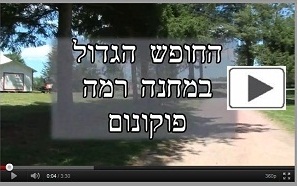
Poconos Video
"HaChofesh HaGadol" video (Ramah Poconos)
 

Special summer highlights. At Ramah New England, a time lapse video reveals the action taking place on the first day of camp. Other highlight videos include a wonderful first week at Ramah Wisconsin; discovering new skills at Ramah Nyack; and Ramah Darom's first-session video yearbook.  


Music, song, and dance. Ramah Poconos produced "HaChofesh HaGadol," a music video combining lip synching and audio dubbing. In celebration of Yom Sport at Ramah Outdoor Adventure, "Team Olive" wrote an original song about friendship. Campers and staff at Ramah Canada sing lines from their favorite Zimriyah songs; and at the Philadelphia Ramah Day Camp, campers perform in The Wizard of Oy


Outstanding Israel educational programming and a love of Israel. Meet the 2011 mishlachat of Ramah Berkshires; visit Eilat at the Chicagoland Ramah Day Camp's Yom Yisrael; and experience the sights and sounds of Eretz Yisrael with Ramah Israel Seminar.


Camper-produced videos. At several Ramah camps, campers can choose to participate in a video chug (activity). Enjoy the Mitzvah Man video of Ramah California's Tikshoret (communications) chug, a day in camp life as seen through the journey of a water bottle at Ramah Outdoor Adventure, and this collection of silent films from Ramah Canada's video chug.


We hope that you enjoy these and the many other videos from Ramah camps and Israel programs! 


Shalom,

Mitchell Cohen

Rabbi Mitchell Cohen, National Ramah Director

www.campramah.org 


Ramah Darom and Silvershein Family Establish
the Andrew Silvershein Memorial Fund


Those wishing to honor the memory of Andrew Silvershein, z"l, can make a donation to the Andrew Silvershein Memorial Scholarship Fund, c/o Ramah Darom, 6400 Powers Ferry Road, Suite 215, Atlanta, GA 30339. Click here to donate online.


Jul 27, 2011

Rosh Hodesh Av with Women of the Wall


Is this email not displaying correctly?
View it in your browser.

Read all about  Tamuz srevices!

"Praying and chanting with Women of the Wall continues to teach me about the ways that women can come together to advance not only our standing but also our understanding of Judaism."
- Liz Piper-Goldberg


Join us to celebrate Rosh Hodesh Av at the Kotel on Monday, August 1, 2011 at 7 AM!
Please bring your own siddur.

If you would like to lead a part of the service or hold our Sefer Torah, please contact us.

To sponsor this month's oneg, please contact us.


הינכן מוזמנות לתפילת ראש חודש אב ביום שני ה-1 באוגוסט בשעה 7:00 בעזרת הנשים של הכותל המערבי, ובהמשך, קריאה בתורה בקשת רובינזון.
אנא הביאו עמכן סידור.
  אם את מעוניינת להיות חזנית, לקרוא בתורה או להחזיק בספר התורה, אנא כתבי אלינו


אם ברצונך לקחת חלק במימון הכיבוד שלאחר התפילה, אנא  כתבי אלינו


Copyright © 2011 Women of the Wall, All rights reserved.

Our mailing address is:
Women of the Wall
POB 31936
Jerusalem, Israel 91319


---
Rabbi Menachem Creditor
Congregation Netivot Shalom  || Bay Area Masorti ||  ShefaNetwork 
Rabbis for Women of the Wall  ||  menachemcreditor.org 
To join Rabbi Creditor's email list, send a blank email to thetisch-subscribe@yahoogroups.com.


Jul 26, 2011

JFCS/East Bay is pleased to co-present the following films at the 31st Annual San Francisco Jewish Film Festival (in Berkeley)

JFCS/East Bay is pleased to co-present the following films at the 31st Annual San Francisco Jewish Film Festival:
  • Mabul (The Flood): (Sunday, July 31, 6:30 pm at the Roda Theatre, Berkeley RepOn a tumbledown collective farm on Israel's coast, the Rosko family struggles to keep up appearances while hiding their sins, small and large, from one another. Teacher Miri (Ronit Elkabetz) is having an affair; husband Gidi is surreptitiously unemployed; and late-blooming son Yoni pacifies class bullies by selling them completed homework assignments. When his autistic brother suddenly rejoins the household, tensions mount, secrets emerge and Yoni's bar mitzvah reading--about Noah and the flood--takes on deeper meanings in this exquisite drama nominated for six Israeli Academy Awards. 
  • Standing Silent: (Monday, August 1, 2:00 pm at the Roda Theatre, Berkeley RepStanding Silent profiles the heroic efforts of Phil Jacobs, a reporter for the Baltimore Jewish Times, as he relentlessly pursues sexual predators, including prominent rabbis and community leaders, in Baltimore's insular Orthodox Jewish community. However, rather than being celebrated for his efforts, Jacobs, an observant Jew, instead faces ostracism from a community more intent on shielding itself from external scrutiny than on protecting its young people from abuse.  

---
Rabbi Menachem Creditor
Congregation Netivot Shalom  || Bay Area Masorti ||  ShefaNetwork 
Rabbis for Women of the Wall  ||  menachemcreditor.org 
To join Rabbi Creditor's email list, send a blank email to thetisch-subscribe@yahoogroups.com.

jpost.com: "Intermarried couples try to raise Jewish children"

[Me: Rabbi Paul Drazen, assistant to Rabbi Steve Wernick: "In Conservative shuls, non-Jews technically may not be members, and one must be a member to hold synagogue office... there are very few "red lines" dictated by the movement hierarchy." We count members as members, Jewish and not. If USCJ disagrees, it is from hierarchical fear.]

 
jpost.com: "Intermarried couples try to raise Jewish children"
http://www.jpost.com/JewishWorld/JewishFeatures/Article.aspx?id=231047
By JTA
26/07/2011
 
SAN FRANCISCO - Lisa Shimel, who is not Jewish, celebrated Christmas with her Jewish husband until their first child was born; now they've added Chanukah. Deb Morandi works at Jewish Family Services, where she introduces intermarried families to Judaism, though she is not Jewish.

Pat Luftman was a committee co-chair in her son's Jewish preschool, but her Jewish husband was denied a board position because the couple was intermarried. The Rev. Eleanor Harrison Bregman accompanies her children and Jewish husband to synagogue on Saturday, then goes to church the next day on her own.

A growing number of non-Jewish parents in America who have no plans to convert are raising Jewish children, marrying Jewish spouses, building Jewish homes and playing active roles in the Jewish community. But without plans to join the faith officially, their place in the Jewish community can be a bit complicated.

"My husband has never asked me to convert, and I feel strongly that I won't, so this is as far as it will go," Morandi, an active member of her Reform congregation, Temple Etz Chaim in Franklin, Mass., said of her synagogue work.

A decade ago, 31 percent of married American Jews had non-Jewish spouses, the 2000-01 National Jewish Population Survey reported. The study, to which there has been no national follow-up, also showed that one-third of the children born to intermarried couples are raised Jewish.

With most intermarriages involving Jewish men and non-Jewish women, a lot of non-Jewish women are leading Jewish lives in everything but name.

To be sure, there are many resources to help them, from national groups to synagogue outreach committees. But each woman's experience is still a unique path she must blaze on her own.

Morandi, who grew up Southern Baptist, says her husband was the first Jewish person she really knew. They didn't think about religion until their twins were born.

The family's decision to create a Jewish home "just sort of evolved," Morandi told JTA, because she and her husband wanted a sense of community and his parents lived nearby while hers did not. They joined the temple where their friends belonged and sent the boys to Tot Shabbat, a preschool program.

"If they choose another path when they grow up, that's fine with us," she said. "We just wanted to give them something."

Morandi says she feels no pressure to convert. Not only are most of their friends intermarried, so are many of the young families she works with at Jewish Family Services in Boston.

Raising Jewish children is even more complicated for a minister. Bregman is unlike most non-Jewish women raising Jewish children in that she actively practices her Christian faith.

She grew up Episcopalian in Savannah, Ga., and says she had "a pretty literalist view of the Bible" when she hit Princeton University. Bregman and her future husband, Peter, struggled with the faith issue. He wanted her to convert, so they took introductory Judaism classes and joined a Jewish text study group.

They married in 1999, and their three children received Orthodox conversions. All are now studying in Jewish schools. Meanwhile, Bregman delved further into her own faith and was ordained as a United Church of Christ minister in 2009.

"There's not been much theological dissonance," she told JTA. "I worked it out in seminary that we each have our own covenants."

Bregman says she doesn't feel out of place at Congregation B'nai Jeshurun, a popular nondenominational synagogue they attend as a family in Manhattan. But when she attends church alone on Sundays, her oldest asks why.

For Shimel, when her children reached school age, she wanted to take them to church, but her Jewish husband wasn't comfortable with it. The couple enrolled in Stepping Stones, a two-year program for interfaith couples in Denver, and by the end of the course Shimel thought she could be comfortable raising the children Jewish. Shimel later become chairwoman of Stepping Stones; she says she's the first Christian to head up a Jewish outreach organization.

Like Morandi, Shimel says she feels no pressure to convert, although some people have suggested it.

"I never felt it was a requirement for our family to participate as fully as we like in Jewish life," she said of conversion. "There are some things I can't do, but it's a reasonable compromise."

Morandi and Shimel belong to Reform congregations, the most liberal of the three major Jewish religious denominations when it comes to ritual roles for non-Jews.

In both the Reform and Conservative movements, individual congregations set their own policies governing which rituals are open to non-Jews, though Reform synagogues tend to be more inclusive.

Typically, non-Jews are permitted to do anything that is not a commandment. Non-Jewish parents may stand on the pulpit during a child's bar or bat mitzvah, for example, but do not say the prayer over the Torah. But some Reform congregations permit non-Jews to take part in every ritual, according to Vicky Farhi, lead outreach specialist for the Union for Reform Judaism. 

In Conservative congregations, non-Jews technically may not be members, and one must be a member to hold synagogue office. But beyond that, there are very few "red lines" dictated by the movement hierarchy, said Rabbi Paul Drazen, special assistant to the CEO of the United Synagogue of Conservative Judaism.

"Each congregation reflects the community within which it is found," he said. "At the same time, it's inconvenient and confusing."

It's also confusing when synagogues don't set policies, or have one and don't publicize it. That's what happened to Luftman and her husband, Henry, an intermarried couple who joined their Conservative synagogue in Allentown, Pa., 17 years ago.

Pat, the non-Jewish spouse, took a very active role in their children's Jewish education, even teaching in the school. Henry, who served on the school board and chaired several subcommittees, wondered why he was never nominated to chair the school board or asked to serve on the synagogue's board of trustees. Four years ago, the cantorial director explained why: His wife wasn't Jewish.

"It hurt us so badly and was insulting on so many levels," Pat told JTA. "And those rules were never written down. It was just 'tradition.'"

Half her community secretly wondered why she didn't convert if she was so eager to be part of the community, Pat said, while the other half thought how wonderful it was that she was raising Jewish children.

The couple thought about leaving the shul but decided instead to stay and change things. The synagogue now has written policies about what non-Jews and intermarried Jewish members may and may not do, and those policies are posted on the congregation's website.

For the Luftmans, it's now a moot question: Pat converted in 2007.

Emotionally, being betwixt and between in the Jewish community can be a rough ride, Bregman said. 

"I had a real moment where I thought, I can't do this," she said. "A minister married to a Jewish man? In the back of my mind I'd always thought that I could convert and be what my children are. Getting ordained was closing off that possibility."

At her child's second-grade class presentation, Bregman says she wept while watching the children read from the Torah and dance around the bimah with their parents.

"This passing down of the Torah to the next generation, I'll never be part of that," she said.

But Bregman chose her path and is now a chaplain at the Jewish Hospital and Home in the Bronx, N.Y. She prays in her way and raises her children as Jews.

"I was trying to fit it all in a box and I realized, I'll always be in between," she said. "It's not an easy place to be."

Print Edition


---
Rabbi Menachem Creditor
Congregation Netivot Shalom  || Bay Area Masorti ||  ShefaNetwork 
Rabbis for Women of the Wall  ||  menachemcreditor.org 
To join Rabbi Creditor's email list, send a blank email to thetisch-subscribe@yahoogroups.com.


---
Rabbi Menachem Creditor
Congregation Netivot Shalom  || Bay Area Masorti ||  ShefaNetwork 
Rabbis for Women of the Wall  ||  menachemcreditor.org 
To join Rabbi Creditor's email list, send a blank email to thetisch-subscribe@yahoogroups.com.

Jul 13, 2011

BJPA eNews: Focusing on Service

Having trouble viewing this email? Click here
Berman Jewish Policy Archive @ NYU Wagner
Berman Jewish Policy Archive @ NYU WagnerNewsletter 
July 2011

Dear Friends,

A few weeks ago, we sent out a special mailing to help launch Repair the World's new study, Volunteering + Values: A Repair the World Report on Jewish Young Adults. In this month's newsletter, we're continuing that theme by highlighting BJPA holdings on the topics of Service and Volunteerism.


Jewish Service in Past Generations

Service as a communal value can scarcely be called new in American Jewish life. Writing in 1914, Ethel C. Meyer discussed Volunteer Social Work as Viewed by a Volunteer. In 1915, Belle A. Lowenstein of Cincinnati described that city's Settlement Volunteer Workers' Association. Two decades later, in 1937, Stella Jessica Schifrin envisioned A Central Committee of Volunteers. In 1938, The Jewish Board of Guardians explained its Volunteer Training Program. Lilly B. Essin discussed Education for Volunteer Participation in Social Work. Daniel Thursz, who would go on to lead B'nai B'rith, described the role of The Volunteer in Social Group Work in 1959.


In the early days of the Kennedy Administration (1962), Gretel Conal adumbrated the discourse in recent years concerning the civic engagement of "the Obama Generation" in Social Service Idealism in the Sixties - An Example. The following year, Dan Ginsberg described a for-credit volunteer program for college students, which can only be described (in contemporary terms) as Service-Learning. So apparently noteworthy were these trends among American Jewry that, in 1972, Ben Lapin lamented that Israel, by contrast, lacked the strong element of volunteerism present in the English-speaking world.


Jewish Service Today

As the aforementioned Repair the World report found, "The majority of contemporary Jewish young adults engage in volunteer work", and a 2008 study of Jewish college students' interest in long-term service found that a third of students "showed at least a moderate level of interest in long-term service options after college." In the same year, a report Jewish Service Learning: What Is and What Could Be: A Summary of an Analysis of the Jewish Service Learning Landscape, concluded that, "Potential demand for Jewish Service Learning outpaces current participation."


Of course, service doesn't only pertain to youth. The 2000-1 National Jewish Population Survey determined that, "Married adults with children have higher levels of volunteering for Jewish organizations than other Jews." Rachel Aber Schlesinger argued in 1998 that senior citizens can provide a unique value to the community as volunteers, and, as David Elcott reported last spring, the Jewish community will have copious opportunities to take advantage of retiring Baby Boomers as volunteers or employees in encore careers during the upcoming generational shift.

Just last month, Brent Spodek and Adam Gaynor pointed out that Jewish organizations often tend to talk about doing service rather than serving, perhaps "in order to get a little bit of psychological distance between ourselves and what we are actually doing, or fear we are doing. Servants serve, servile people serve, but people of privilege 'do service.'"


Purposes of Jewish Service

While I don't see the dual goals of making a real difference (authentic service) and enhancing Jewish identity as being in conflict, they are in tension, and the over-emphasis on the putative educational aspects of service can diminish the positive social impact that make for authentic, high-quality service.

 As I wrote in 2001 for an issue of Contact dedicated to Jewish Service, community service stands at The Nexus of Volunteerism, Philanthropy, and Jewish Identity. In the same issue, Rabbi Yitz Greenberg argued that "the infinite worth of other people" is A Central Jewish Norm for Our Time. Similarly, Rabbi Jennie Rosenn argued in Sh'ma in 2004 that service ought to be At the Core of Jewish Citizenship. This idea is also guides the work of AVODAH: The Jewish Service Corps, founded by Rabbi David Rosenn in 2004 (and which he described for CAJE in 2001, and for Sh'ma in 2006.)


At a 2002 CLAL Seminar, Ruth Messinger, President of American Jewish World Service, noted that a strong communal commitment to service would "make a contribution in a world in which there will be an increasing need for cross-cultural experiences that promote cross-cultural understanding." Nor is she alone in highlighting the potential for service to build bridges; writing in The Reconstructionist in 2007, Nathan Martin examined service-learning as A New Model for Muslim-Jewish Dialogue. In a 1983 issue of the Journal of Jewish Communal Service, Donna Gold Rothstein described how a Voluntary Neighborhood Intergenerational Program broke down barriers of age, race and religion. In 2007, the American Jewish Committee's Task Force on National Service called for the creation of a civilian national service corps as a unifying experience for all Americans.


Effectiveness of Jewish Service

Several social scientific evaluations of individual programs' effectiveness have been undertaken. In 2006, the Cohen Center for Modern Jewish Studies (CMJS) published an evaluation of the service corps operated by the International Commission on Holocaust Era Insurance Claims, documenting positive outcomes both for the youth engaged in serving Holocaust survivors, and for the survivors themselves. CMJS also published evaluations of The UJA-Federation of New York's Break New Ground (BNG) Jewish Service-Learning Initiative in 2008, 2009 and 2010. Later last year, BTW Consultants and Repair the World released The Worth of What They Do: The Impact of Short-term Immersive Jewish Service-Learning on Host Communities -- An Exploratory Study.


These are but some of the Jewish communal and academic literature on service in Jewish life that stretches back at least a century and, of course, back to the time when God called upon Abraham to serve Him. The recent upsurge in Jewish policy-makers' interest in service betokens not only ongoing programs and innovation in this area, but further research and policy discourse. We invite you to continue the conversation and explore our resources on Volunteerism, Communal Responsibility, Service, and Global Responsibility.


With best wishes,

Steven 


Prof. Steven M. Cohen

Director, Berman Jewish Policy Archive @ NYU Wagner  


BJPA is pleased to announce that the complete 41-year collection of Sh'ma: A Journal of Jewish Responsibility is now available, as part of our open, searchable Archive. This digital resource, launched jointly by Sh'ma and the BJPA is available at www.shma.com or www.bjpa.org. It features the work of a vast array of Jewish leading intellectuals, including rabbis, scholars, educators, and lay leaders.


11,000 DOCUMENTS...AND GROWING!

 
Some of our latest additions: 

An Open Letter, Charles Bronfman and Jeffrey Solomon (July 2011)
  

Are American Jews About to Follow the Canadian Pattern? Brent Sasley (July 2011)


Volunteering+Values: A Repair the World Report on Jewish Young Adults, CMJS, Gerstein|Agne Strategic Communications, Repair the World (June 2011)


Love, True Love, and Statistics, Elliot Jager (June 2011)


Analysis of Leadership in Three Jewish Congregational Schools: Implications for Academia, Elissa Kaplan (June 2011)


Ten Years Later, Birthright Still Reaching Young Jews, Leonard Saxe and Jeffrey Solomon (June 2011)


Loyalty and Criticism in the Relations between the World Jewry and Israel, Gabriel Sheffer (June 2011)


Post-Soviet Jewry on the Cusp of its Third Decade - Part 2, Betsy Gidwitz (June 2011)


Who Calls the Shots? An inquiry into the effect of Jewish and Arab lobbies on Canadian Middle East Policy, Brent Sasley (May 2011)


Post-Soviet Aliyah and Jewish Demographic Transformation, Mark Tolts (August 2009)  


Click HERE for new publications   


Click HERE for latest additions.

  From the J-Vault: Censorship & Sensitivity


 This week, from the J-Vault: Objectionable Films (1915)


Last month, the US Supreme Court struck down a California law banning the sale of violent video games to children. Defenders of the law used various (unsuccessful) lines of reasoning, such as arguing that harm to children takes priority over other concerns, and arguing that minors do not have the same free speech rights as adults. None of the law's defenders, however, could be seen explicitly endorsing censorship, or even using the word "censorship".


But that's only because times have changed.


This little report from the November 1915 Bulletin of the National Conference of Jewish Charities was obviously not particularly noteworthy at the time, but viewed from 2011, it provides a fascinating glimpse into a time when there was a "National Board of Censorship of Motion Pictures".

The National Board of Censorship of Motion Pictures has just issued a special bulletin to all producers and directors of motion pictures in the United States. This is the first definite step taken by the Board to check the vilification of the Jewish race in the "movies." Acting in co-operation with the Jewish Community (Kehillah) of New York City, Maurice Simmons, chairman of the Committee for the Protection of the Good Name of Immigrant Peoples, has been in constant touch with the National Board of Censorship. The libeling of the Jew in the "films" had assumed alarming proportions and was the subject of complaint all over the country.

Don't you wish we still had a "Committee for the Protection of the Good Name of Immigrant Peoples"? Americans used to be much better at naming things. Also, isn't it quaint to reflect that there used to be a time when Jews were portrayed in "movies" and "films" as falling into a set of stereotypical roles? Oh, wait a minute... 


On a more serious note, it may come as a surprise to modern American Jews, who are accustomed to seeing Jewish communal institutions stand generally on the side of civil liberties, that in 1915 Jewish community institutions apparently felt no tension about, or even any need to explain, appealing to the National Board of Censorship.


Download this publication... 


And be sure to check out earlier editions of the J-Vault


Follow BJPA on Twitter and become our fan on Facebook!


BJPA is funded by the Mandell L. and Madeleine H. Berman Foundation and the Charles H. Revson Foundation. 


Total Pageviews